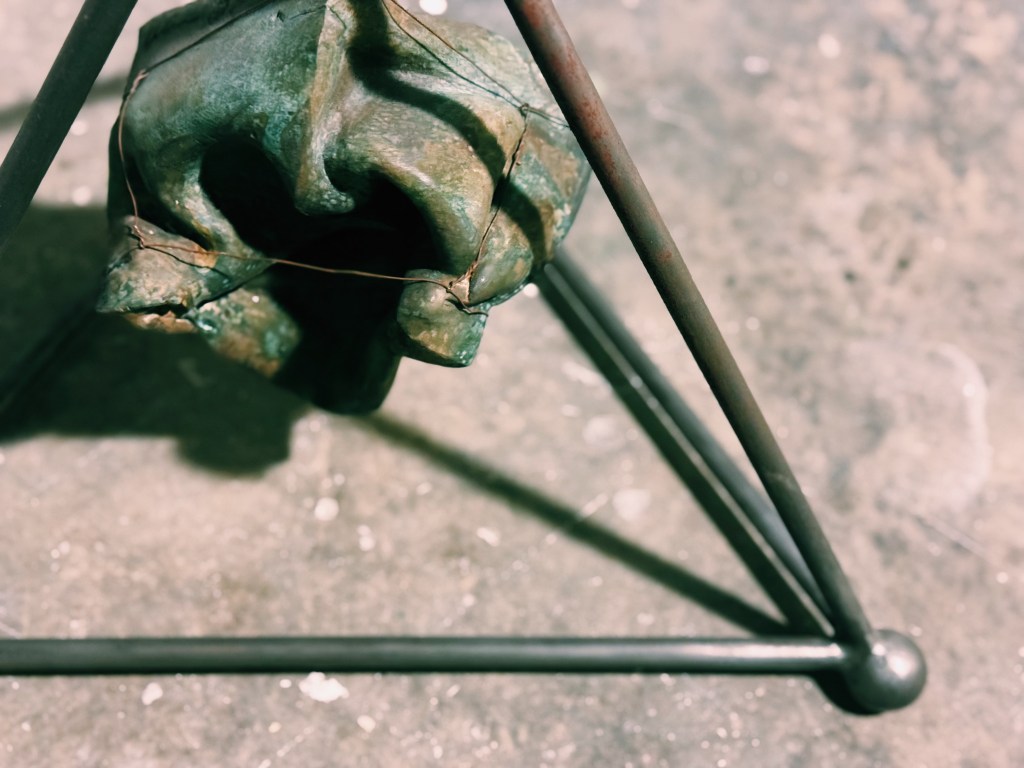
Sculpture has long been seen as a vehicle for expression—a way to capture the human condition in three-dimensional form. For me, sculpture is more than that. It’s an investigation. A search. A pursuit of knowledge through the language of form. I’m interested in how shapes, volumes, and voids can speak to our deepest instincts and emotions—just as vividly as colour does in painting. This essay is a reflection on that idea, through the lens of artists who have shaped my thinking and forged paths toward a purer, more elemental form of expression.
Take Bernini’s Ecstasy of Saint Teresa. Her poised, ecstatic form evokes not only powerful emotions but unmistakably sensual connotations. I believe it’s possible to distill that form down to its most basic constituents—to find a pure form that elicits such a response at an instinctual level.
Constantin Brancusi immediately comes to mind as one of the modern artists who paved the way in this direction. In Bird in Space, he stripped away any literal representation of a bird, focusing instead on the sensation of flight through polished, soaring abstraction. Brancusi believed that one must “feel shape simply as shape, not as description,” aiming for universal forms—like shells or pebbles—that resonate with the subconscious.
Barbara Hepworth, a pioneer of direct carving, worked with stone and wood to enhance the natural qualities of her materials. She often said that form should be “viewed as if found within the respective cube,” as if the shape emerged organically from the material itself. Her use of organic geometry—curving masses punctuated by voids—created a harmony between interior and exterior. For Hepworth, abstraction offered access to vitality, power, and a spiritual life beyond mere physical representation.
Peter Voulkos embraced simplicity and spontaneity, letting his process guide the form. With raw, tactile engagement at the heart of his clay work, he explored the tension between structure and improvisation, treating imperfections as emotional touchpoints. “I get down to the very basic forms that I really love,” he once said, “but they are still giving me information.”
What connects these artists—Brancusi’s ethereal abstraction, Hepworth’s organic harmony, and Voulkos’s raw spontaneity—is their shared commitment to distilling form down to its essential core. Each of them sought to bypass the literal and touch something more universal, more intuitive. This is the path I find myself drawn to in my own work: stripping away ornamentation, letting material and instinct guide the process, and searching for the forms that don’t just represent feelings—but evoke them. Like the masters before me, I’m not chasing likeness—I’m chasing truth, in shape.
 Christopher Chetcuti
Leave a comment